How to Count Macros for Beginners: Simple Guide
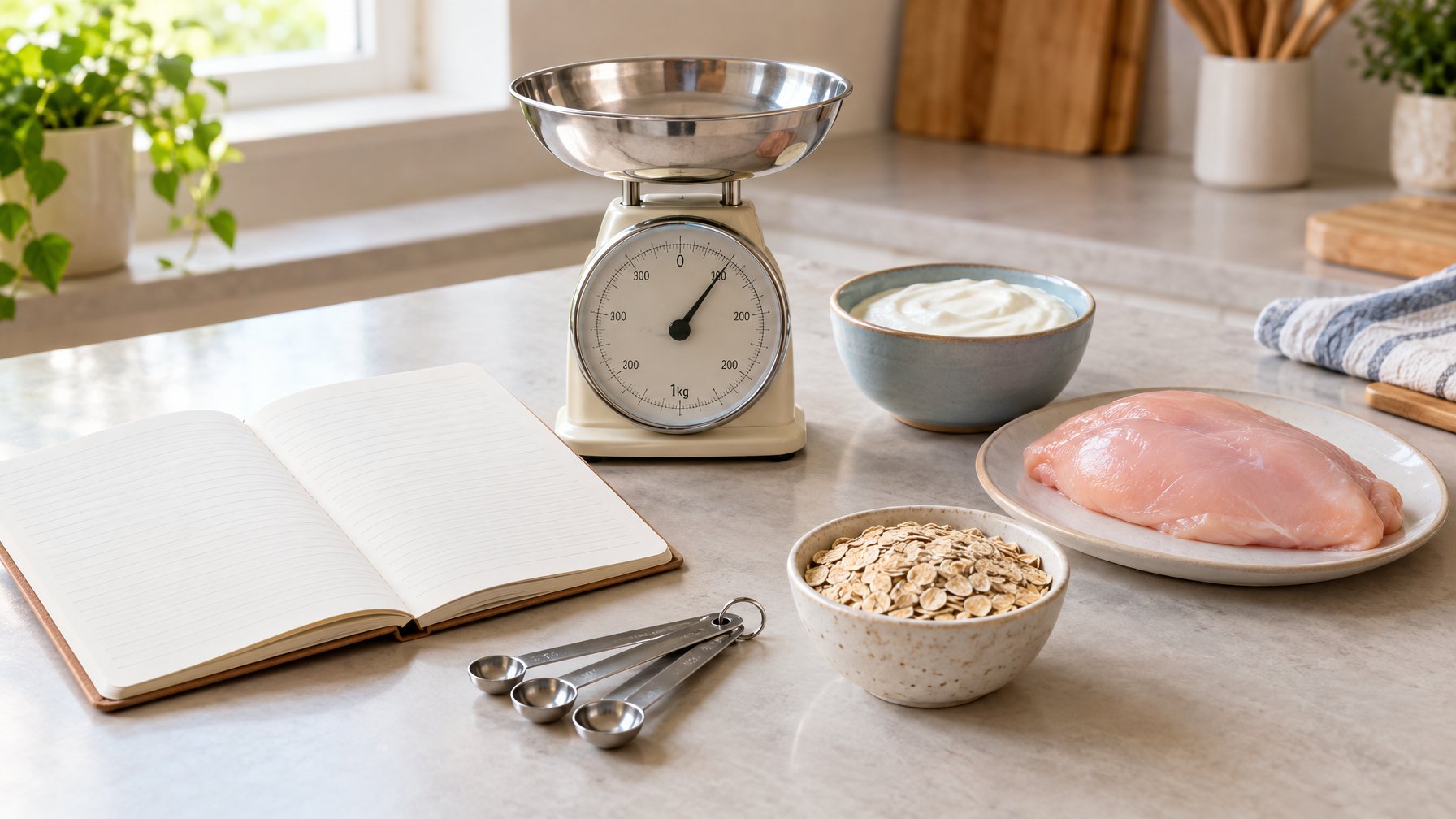
Counting macros means tracking the grams of protein, carbohydrates, and fat eaten each day so total calories and the composition of those calories both land where they need to be. Beginners get the fastest results from a three-number setup: estimate daily calories from body weight and activity, set protein at roughly 0.7 to 1.1 grams per pound, fix fat at a floor near 0.3 to 0.4 grams per pound, and let carbohydrates absorb whatever calories remain. Everything else is logging practice.
The appeal of macro tracking over plain calorie counting comes down to control over body composition. Calories decide whether body weight moves up or down; the protein number influences how much of that change comes from fat versus lean tissue. That distinction drives most fitness goals, from a first cutting phase to a slow muscle-gain push.
Tracking also teaches portion awareness that outlives the spreadsheet. After a few weeks of weighing rice and peanut butter, most people can estimate a plate within a reasonable margin without opening an app at all. Macro counting works best as a skill-building phase of four to eight weeks, with periodic check-ins afterward.
Key Takeaways
- Macro targets start with a calorie estimate, then protein and fat floors, with carbs filling the gap.
- A $10 to $15 digital kitchen scale removes the single largest source of tracking error.
- Consistency across a full week beats hitting every gram perfectly on any single day.
Macros, Calories, and Your Goal
Protein, carbohydrates, and fat are the three macronutrients that supply all dietary energy, and each carries a fixed calorie value per gram. Knowing those values, plus a clear goal, is enough to turn a calorie target into gram targets.
What Are Protein, Carbohydrates, and Fat?
Protein supplies amino acids for muscle, connective tissue, enzymes, and hormones. It also blunts appetite more than the other two macros, which matters during a calorie deficit.
Carbohydrates break down into glucose and fuel brain function along with higher-intensity training. Sources range from oats and rice to fruit, beans, and vegetables.
Fat supports hormone production, cell membranes, and absorption of vitamins A, D, E, and K. Olive oil, nuts, seeds, avocado, butter, and fatty fish all contribute.
Why Macro Tracking Is Different From Calorie Counting
Calorie counting tracks total energy intake and nothing more. Macro tracking captures that same total while showing where the calories came from, which is the information needed to protect lean body mass during fat loss or support muscle gain during a surplus.
Two 1,600-calorie days can produce different outcomes in body composition when one delivers 130 grams of protein and the other delivers 45. Flexible dieting, sometimes called IIFYM, builds on this idea: food choices stay open as long as the gram totals land.
Protein also carries the highest thermic effect of food among the three macros, meaning a larger share of its calories is spent on digestion.
How Calories per Gram Add Up
The conversion math never changes:
| Macronutrient | Calories per gram |
|---|---|
| Protein | 4 |
| Carbohydrates | 4 |
| Fat | 9 |
Those figures come straight from standard nutrition reference values and are the numbers every tracking app uses. Fat carrying more than twice the calories per gram of protein or carbohydrate explains why a careless pour of cooking oil distorts a day faster than an extra serving of rice.
Choose a Goal: Fat Loss, Maintenance, or Muscle Gain
One goal at a time keeps the numbers coherent. Fat loss runs a calorie deficit, maintenance matches intake to expenditure, and muscle gain runs a modest surplus.
A conservative starting point for fat loss is a 200 to 500 calorie daily deficit, which supports steady progress without the energy crash and hunger that derail aggressive cuts. For muscle gain, a 200 to 300 calorie surplus is enough for most people who train regularly.
Anyone managing a medical condition, pregnancy, or a history of disordered eating should work with a physician or registered dietitian before setting calorie targets.
Set Calorie and Macro Targets
Macro targets follow a fixed order: calorie needs first, then protein, then a fat floor, then carbohydrates. Skipping the order produces splits that look balanced on paper but leave protein too low to hold onto muscle.
Estimate Your Total Daily Energy Expenditure
Total daily energy expenditure covers basal metabolic rate, the thermic effect of food, daily movement, and exercise. The quickest estimate multiplies body weight in pounds by an activity number:
- Sedentary desk job, no exercise: 12 to 13
- Lightly active, 1 to 3 workouts weekly: 13 to 14
- Moderately active, 3 to 5 workouts weekly: 14 to 16
- Very active, 6 or more workouts weekly: 16 to 18
A 170-pound moderately active person lands near 2,550 calories for maintenance using a multiplier of 15, per this quick-estimate table.
Treat that figure as a first draft. Real expenditure varies, and wearable estimates are unreliable: a Stanford study of seven popular devices found the most accurate was still off by 27% on energy expenditure.
How to Use BMR and an Activity Factor
The Mifflin-St Jeor equation gives a more individualized basal metabolic rate:
- Men: (10 × weight in kg) + (6.25 × height in cm) − (5 × age) + 5
- Women: (10 × weight in kg) + (6.25 × height in cm) − (5 × age) − 161
Multiply the result by an activity factor: 1.2 sedentary, 1.375 lightly active, 1.55 moderately active, 1.725 very active, 1.9 for hard daily training plus a physical job.
A worked example: a 30-year-old woman at 160 pounds (73 kg) and 5'4" (163 cm) has a BMR near 1,438 calories, and at lightly active that works out to roughly 1,977 calories of daily expenditure. A systematic review of predictive equations identified Mifflin-St Jeor as the most accurate, landing within 10% of measured resting metabolic rate for most healthy adults.
Set Protein and Fat Before Filling in Carbs
Protein comes first because it has the strongest evidence tying a specific intake range to body composition outcomes. The International Society of Sports Nutrition's position stand recommends 1.4 to 2.0 grams per kilogram of body weight daily for exercising individuals, and a 2018 meta-analysis of 49 studies found benefits to fat-free mass plateauing around 1.6 g/kg/day.
In pounds, that translates to about 0.7 to 1.0 gram per pound, with fat loss phases sitting at the upper end.
Fat gets a floor, not a ceiling: 0.3 grams per pound minimum, or 20 to 25% of total calories. Going below that chronically risks hormonal disruption.
Carbohydrates take the remainder. They are the most flexible macro, and a 2025 network meta-analysis in Nutrients found that when protein was matched, different carb-to-fat ratios produced similar body composition outcomes.
Convert Your Daily Calories Into Macro Grams
The arithmetic runs in four steps. A 150-pound moderately active woman targeting fat loss:
- Maintenance estimate: 150 × 14 = 2,100 calories
- Fat loss target: 2,100 − 400 = 1,700 calories
- Protein: 150 × 1.0 = 150 g (600 calories)
- Fat: 150 × 0.35 = 53 g (477 calories)
Remaining calories: 1,700 − 600 − 477 = 623, divided by 4 = 156 g carbohydrates.
Final targets: 1,700 calories, 150 g protein, 156 g carbs, 53 g fat. Any macro calculator runs this same sequence in seconds, which saves the math without changing the logic.
Log Food Accurately Without Overcomplicating It
Accurate logging depends on two purchases and one habit: a digital food scale under $15, a tracking app with a barcode scanner, and the discipline to log cooking oils. Self-reported intake fails badly without those; a 1992 study in the New England Journal of Medicine found diet-resistant subjects underreported calories by an average of 47%.
Choose a Macro Tracking App That Fits Your Budget
Most beginners do well with whichever app they will open on day five. Published pricing and positioning differ:
| App | Free version | Premium price | Notable strength |
|---|---|---|---|
| MyFitnessPal | Yes | $79.99/year | 14M+ food database, barcode scanner |
| Cronometer | Yes | $49.99/year | Verified entries, micronutrient detail |
| MacroFactor | No | $71.99/year | Adaptive target adjustment |
| Lose It! | Yes | $39.99/year | Simple interface, photo recognition |
Those figures come from a documented feature and pricing comparison of the four apps. Carbon Diet Coach also sits in the adaptive-coaching category alongside MacroFactor.
For a first month, the free tier of MyFitnessPal or Cronometer is enough.
How to Weigh Food and Read a Nutrition Label
Set the scale on the counter, place the bowl on it, press tare to zero out the container, then add food and read grams. Grams beat ounces for precision, and any $10 to $15 scale with a tare function does the job.
Nutrition labels list macros per serving, so check the serving size before logging. A "serving" of cereal is frequently half of what ends up in the bowl.
One detail trips up nearly everyone: dry versus cooked weight. Roughly 100 grams of dry rice becomes about 300 grams cooked, so logging a cooked weight against a dry database entry understates intake by two-thirds.
Build Meals Around Protein, Produce, and Flexible Staples
The fastest way to hit macros is to anchor each meal with a protein source, add vegetables or fruit for volume and fiber, then fill remaining calories with a starch.
Protein anchors: chicken breast, eggs, salmon or white fish, Greek yogurt, tofu, beans, and a protein shake when a meal falls short. Starches that log cleanly include rice, oats, quinoa, potatoes, and sweet potato.
Healthy fats from avocado, nuts, seeds, and olive oil count fast at 9 calories per gram, so weigh them. Meal prep helps here: cooking a batch of protein and a batch of grain on Sunday means most weekday logging becomes a repeat entry.
Find and Fix the Tracking Gaps That Matter Most
Four blind spots account for most of the gap between logged and actual intake:
- Cooking oils. One tablespoon of olive oil runs 120 calories, and two or three go into the pan unlogged.
- Sauces and dressings. A generous pour of ranch or teriyaki adds 100 to 200 calories.
- Liquid calories. A large whole-milk latte exceeds 200 calories; three daily is a 600-calorie hole.
- Bites and tastes. Four forkfuls of someone else's dessert is a snack.
Log protein and total calories precisely. Let carbs and fat float within a 10 to 15 gram band, which keeps the process workable without changing outcomes for most people.
Build a Routine You Can Sustain
Macro counting succeeds on consistency across a full week, not perfection on any single day. A week where six days land within 100 calories of target and one day runs over will move body composition; a week abandoned on day four will not.
Log meals as they are eaten instead of reconstructing the day at bedtime. Pre-logging the next day's meals in the morning takes about three minutes and turns tracking into a plan.
Weigh in the same way several mornings a week and average those numbers. Weekly averages filter out the water-weight noise that makes daily scale readings misleading, and two to three weeks of trend data is the right window before changing calorie or macro targets.
Metabolic adaptation is real: daily energy expenditure drops during extended fat loss beyond what body mass changes predict. That is why static macros stop working after four to six weeks and why a recalibration step belongs in the routine.
During a cutting phase, expect one target adjustment every three to four weeks.
Energy levels, training performance, and hunger give useful feedback alongside the scale. Persistent fatigue during a deficit frequently traces to carbohydrates set too low, and flat workouts respond to shifting some fat calories toward carbs while holding the calorie total.
Tracking every day forever is not the goal. Most people track closely for four to eight weeks, build reliable portion awareness, then move to logging one or two meals a day or doing a check-in week each month.
Wrapping Up
Macro counting turns a calorie target into three actionable numbers, and the order of operations is what makes it work: calories from body weight and activity, protein from body weight, a fat floor for hormone health, then carbohydrates filling the remainder.
The tools stay cheap. A $10 digital scale, a free app tier, and the habit of logging oils and sauces cover the accuracy that matters.
Weigh dry pasta and rice before cooking, tare the container, and check serving sizes on labels. Give any set of targets two to three weeks of weekly weight averages before adjusting, and expect to recalibrate every three to four weeks during an extended deficit.
Anyone with a medical condition or a history of disordered eating should set these numbers with a registered dietitian rather than a calculator.
Frequently Asked Questions
How do beginners calculate their ideal macros?
Estimate maintenance calories by multiplying body weight in pounds by 12 to 18 depending on activity, adjust up or down 200 to 500 calories for the goal, then set protein at 0.7 to 1.0 g per pound and fat at 0.3 to 0.4 g per pound. Remaining calories divided by four gives carbohydrate grams.
A macro calculator runs the same sequence automatically.
Should I count macros or just calories for weight loss?
Calories drive weight change, so calorie counting alone works for weight loss. Tracking macros adds control over how much of that loss comes from fat versus muscle, mainly through the protein target, which makes it the better choice for anyone focused on body composition rather than scale weight alone.
What is a good macro ratio for beginners?
A workable starting split is 30% protein, 40% carbohydrates, and 30% fat, which sits inside the USDA Dietary Guidelines ranges of 45 to 65% carbs, 20 to 35% fat, and 10 to 35% protein.
Setting protein and fat in grams per pound first tends to produce better-fitted numbers than starting from percentages.
Can I track macros without an app?
Yes. A notebook plus nutrition labels works, and tallying grams of protein, carbs, and fat per meal takes a few minutes per day.
The trade-off is manual math for unlabeled foods like produce and restaurant meals, where an app's database saves considerable time.
Do I need to weigh every food on a digital food scale?
Weigh the calorie-dense items: oils, nut butters, cheese, nuts, and dry grains. Vegetables and most fruit can be estimated without meaningful error, and packaged single-serving foods only need the label.
Precision where the calories concentrate delivers most of the accuracy benefit.
How long should I track macros before adjusting my targets?
Hold targets for two to three weeks and compare weekly weight averages before changing anything. Metabolic adaptation means most people need a recalibration every four to six weeks during an extended fat loss phase, adjusting calories by 100 to 200 at a time.